Filleting & Butchery
This is a work in progress.
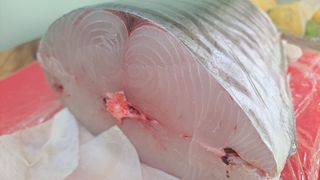
A beautiful piece of Spanish mackerel
Please note that I'm talking about rather large pelagic fish like tuna and mackerel here. Smaller fish should follow the same principles, but perhaps with some common sense adjustments.
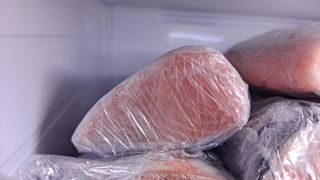
Fillet, double-wrapped, in the fridge
While it's impressive to see someone strip large fillets off a fish in seconds, I find it kinda ridiculous. This is not the best way to store the fish and you're wasting a lot by throwing away the skin, bones, collar, head, and fins.
It's devastating to see people throw out huge frames and skin when there are great uses for it. I get it though! It does require more labour as well as fridge/freezer space, but it's worth knowing what's possible. I don't think people realise how delicious fish stock makes things or that you can make stock from Longtail Tuna and Spanish Mackerel.
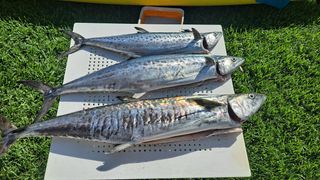
A morning's haul ready for processing
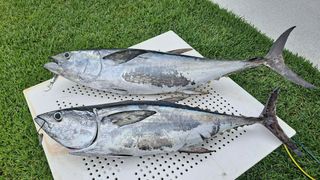
Oh delicious tuna
I'd love to use the guts and gills for crab bait, but at the moment those are the only things that go to waste.
Remove gills/guts, but keep it intact
The longer you can keep the meat in the skin, the longer it's going to last. The ideal way is to simply gut the fish and hang it up to "dry age". Most people don't have a spare fridge that can do this, me included. So here's what I do...
Once back from fishing I want to get my fish stored away as quickly as possible. Many people use a large esky or insulated fish bag with ice to store the fish on their way home. I have the luxury of living on the beach so I'm already home and this is the process I follow:
- Remove the guts and the gills. It's messy and best done out to sea, which is what I normally do.
- Remove the fins, tail, and head. Keep in freezer in a small bag for stock.
- Cut the fish into chunks, just enough so that the chunks fit in the fridge or as the width of 1-2 portions (about 20cm).
- Place the chunks in a fish box (I use a 7.5L Sistema container) or place paper towel on each end and wrap each chunk in cling wrap.
- Refrigerate it until you're ready to process it further.
When I'm ready to use the fish I simply cut off what I need and store the remaining chunk back in the fridge. All skin and bones that I cut off go into little cling-wrapped parcels that I store in the freezer until there's enough to make stock.
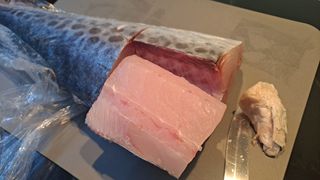
Spotted mackerel fillet
I eat the fish raw as sashimi for up to 5 days and have no problem cooking fish that's 7 days old if stored properly. Just smell it. It shouldn't have a strong smell and I think your ancient nose technology will be able to detect if it's off. I trust my senses.
The collars
Just below the head of the fish are the fish collars. Many people just cut these off and throw them out with the head, but these are great grilled and many chefs love them. They're messy, have quite a few bones, and I like to refer to them as a "fisherman's meal". They're usually the first thing I eat. Cut them off, put some wet rub on them (I like Tom Yum, but any chili paste would work) and throw them on the BBQ.
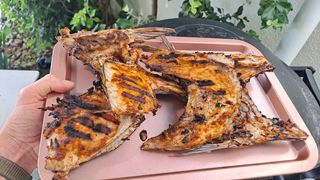
Grilled fish collars
Top part
The top half of the fish is good for sashimi and ceviche. Much better than the tail which has more tendons. So I tend to prioritise it for this, at least initially. But of course it's also good for any other way you'd like to cook it.
Bottom part
The closer to the tail of the fish that you get, the more tendons. For this reason I tend to fry the flesh from very last end or make mince or fish taco bits from it.
How not to do it
Some of the top-ranking content is an absolutely horrible demonstration. It leaves all flesh on the fish.
Don't blunt your knife
This took me a while to learn. With small fish you can normally cut through the skin. But with bigger fish and especially tough-skinned tuna you should probably release the skin first. I use a separate knife for this as the skin really blunts the knife.
Blunt knife
If you have nothing but blunt knives you're going to have to work a bit harder. I think the trick in this case is to do multiple long cuts. First you release the skin by cutting a few mm through it on either side of the spine and belly. You may have to cut a few times to do this. The idea is long strokes from the head to the tail of the fish (or from wherever the skin is not yet released), not back and forth!
Once the skin is released you can cut through the flesh. Again, because you have a blunt knife just do long strokes along the spine. It's fine to cut through a few bones, you just have to remove them after you've released the fillet.
To get the skin off it's the same process - many long cuts, starting from the tail. You hold on to the skin and don't press on the knife too hard.